




- 手机:13761418683
联系人:爱必信
网址:http://www.absin.cn/
地 址:上海市浦东新区新浩路58号18号楼

高分文献解读|SlSLAH2 调控番茄铝胁迫下苹果酸外排 Absin 助力植物抗逆基因表达分析
2026-09-08
一、文献基础综述
· 期刊:Nature Communications(2026,IF=18.1,中科院 1 区)
· DOI:10.1038/s41467?026?71651?1
· 论文标题:SlSLAH2 mediates malate exudation and contributes to aluminum tolerance
· 作者:Danhui Dong 等,通讯作者:Na Zhang、Yang?Dong Guo(中国农业大学)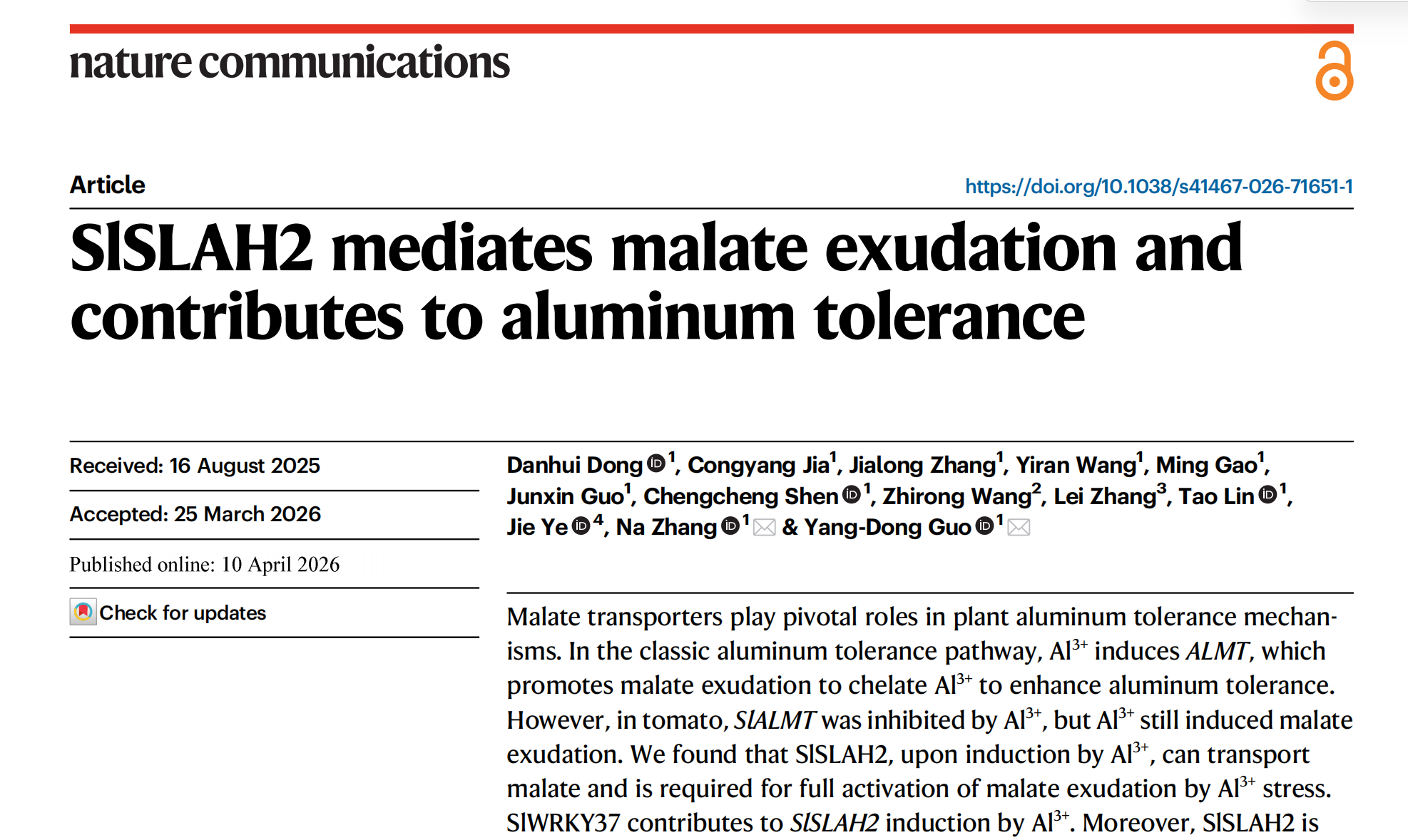
核心结论:番茄中经典耐铝通路 SlALMT 家族受 Al3?抑制,但依然存在苹果酸外排;本研究鉴定慢速阴离子通道SlSLAH2是介导该苹果酸外排关键质膜转运蛋白。转录层面转录因子 SlWRKY37 直接激活 SlSLAH2 转录;翻译后修饰层面,Ca2?依赖激酶 SlCDPK21 磷酸化 SlSLAH2 的 Thr167 激活通道活性,而磷酸酶 SlPP2C72 介导其去磷酸化;Al3?同时在转录、蛋白活性双重层面抑制 SlPP2C72,形成 “双重校验” 的转录?磷酸化级联,保障铝胁迫下番茄根系高效苹果酸分泌,提升耐铝能力,揭示番茄区别于拟南芥、小麦的新型耐铝分子通路。
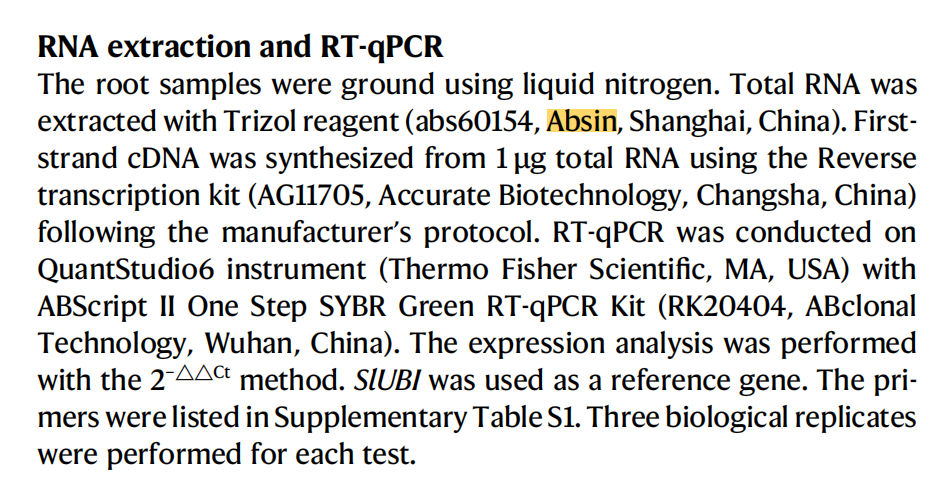
爱必信 Absin 产品应用简述:本研究使用abs60154 Trizol 试剂提取番茄根系总 RNA,获得高质量 RNA 模板,为 RT?qPCR、转录组测序等基因表达分析提供可靠核酸原料,支撑转录水平整套实验数据输出。
二、研究领域背景介绍
全球约 40% 耕地属于酸性土壤,当土壤 pH<5.5 时,铝元素转化可溶性 Al3?,损伤植物根尖,抑制水分与养分吸收,铝毒是仅次于干旱的第二大非生物胁迫因子。植物耐铝主要分为外部排斥、内部耐受两大策略;根系分泌苹果酸、柠檬酸等有机酸螯合根际 Al3?,是最经典的外部排斥解毒机制。
在小麦、拟南芥、大豆中,ALMT 家族是核心铝激活苹果酸转运蛋白,Al3?诱导 ALMT 转录,驱动苹果酸向外释放。但在番茄中发现特殊现象:Al3?处理抑制 SlALMT 家族基因表达,可番茄根系依旧能够分泌苹果酸,暗示番茄存在 ALMT?非依赖型苹果酸外排通路,对应的转运蛋白与调控网络尚不清晰。SLAC/SLAH 慢速阴离子通道家族既往主要研究气孔调控、氮钾稳态,已知具备苹果酸通透能力,但该家族是否参与植物铝胁迫响应,缺乏系统的功能与分子机制解析。针对以上科学问题,该论文围绕番茄 SlSLAH2 开展完整的功能与调控网络解析。
三、作者整体递进研究思路总结
全文遵循表型发现→候选基因筛选→蛋白生化功能验证→上游转录调控解析→翻译后磷酸化调控解析(激酶?磷酸酶模块)→遗传回救→工作模型构建的完整植物分子遗传研究逻辑链:
1. 表型确认:铝处理番茄,证实 Al3?抑制 SlALMT,但根系仍存在显著苹果酸外排,提出存在 ALMT?非依赖转运通路;转录组筛选响应铝胁迫的 SLAC/SLAH 家族基因,锁定 SlSLAH2 作为核心候选。
2. 蛋白功能验证:大肠杆菌回补、爪蟾卵母细胞电生理、亚细胞定位确认 SlSLAH2 是定位于质膜的苹果酸转运蛋白;CRISPR 敲除、过表达材料体内生理表型验证 SlSLAH2 在铝胁迫下苹果酸外排、耐铝的生理功能。
3. 转录调控研究:排除 SlSTOP1 直接调控,筛选上游转录因子 SlWRKY37;通过 Y1H、EMSA、双荧光素酶、遗传材料证明 SlWRKY37 直接结合 SlSLAH2 启动子 W?box 激活其转录。
4. 翻译后修饰筛选:证实 Al3?诱导 SlSLAH2 发生磷酸化;筛选 Ca2?依赖激酶 SlCDPK21,通过互作、体外激酶、质谱位点鉴定、遗传材料证明 SlCDPK21 磷酸化 Thr167 激活 SlSLAH2。
5. 负调控因子挖掘:鉴定磷酸酶 SlPP2C72,体外去磷酸化实验、遗传材料证明 SlPP2C72 负调控 SlSLAH2;进一步证明 SlCDPK21 同时磷酸化 SlPP2C72 抑制其磷酸酶活性,加上 Al3?转录水平下调 SlPP2C72,构成双重校验。
6. 整合遗传证据构建转录?磷酸化协同工作模型,同时讨论 SlSLAH2 与 SlSLAH1、液泡 SlALMT9 之间协同工作模式。
四、分模块详细研究思路、实验结果、对应图片
模块 1:表型确认,转录组筛选候选基因 SlSLAH2
研究逻辑:确认铝胁迫下番茄苹果酸分泌表型,转录组检测 SlALMT、SlSLAC/SLAH 家族表达变化,锁定铝显著诱导的 SlSLAH2 基因。
核心实验:Al3?处理番茄,根系苹果酸外排测定;RNA?seq 热图分析 SlALMT、SlSLAC/SLAH 家族;RT?qPCR 时间梯度表达分析。
爱必信产品实验步骤:取铝处理不同时间梯度的番茄根尖组织液氮研磨,使用abs60154 Trizol 试剂提取植物总 RNA,反转录获得 cDNA,用于 RT?qPCR 检测 SlALMT、SlSLAH 家族基因表达。
关键实验结果:
Al3?处理显著诱导番茄根系苹果酸分泌(Fig.1a)。
转录组热图显示几乎全部 SlALMT 基因被 Al3?处理抑制(Fig.1b);而 SlSLAC/SLAH 家族多个成员上调,SlSLAH2 诱导幅度最高。
RT?qPCR 时间梯度证明 SlSLAH2 随 Al3?处理时间表达持续升高。
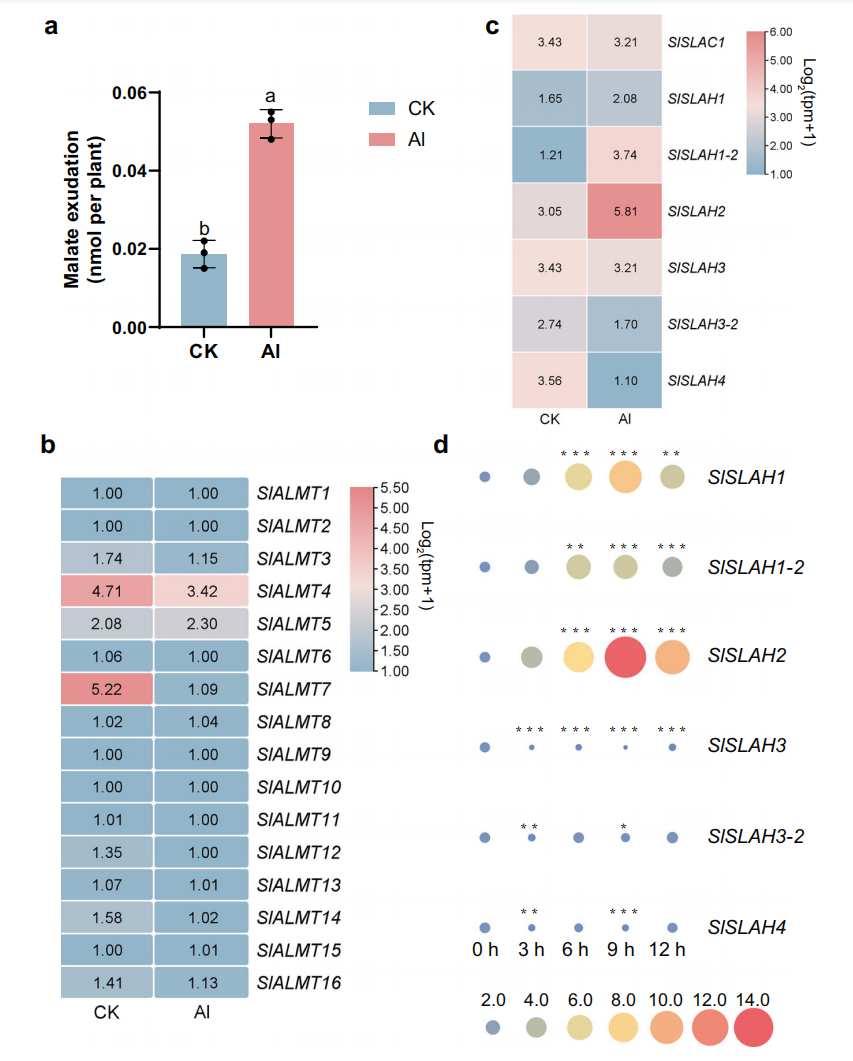 Fig. 1 | Al3+ induced expressions of SlSLAC/SLAHs instead of SlALMT in tomato. a Malate exudation in roots of MicroTom WT. One?month?old tomato plants were treated with 0.5 mM CaCl2, 90 μM AlCl3 (pH 4.7) for 12 h. Data were presented as means ± SD (n = 3). Statistical significance was analyzed by unpaired two?tailed t test; different lowercase letters indicated significantly different means (p ≤ 0.05). Heatmap analysis of (b) SlALMT and (c) SlSLAC/SLAHs gene expression in MicroTom WT treated with or without 60 μM AlCl3 for 9 h (pH 4.7). Expression values were shown as log2 (tpm+1) (n = 3). d The expression levels of SlSLAC/SLAHs were detected by RT?qPCR in 14?day?old MicroTom under 60 μM AlCl3 (pH 4.7) treatment in 12 h. SlUBI was used as reference gene. Bubble size and color lightness corresponded to relative expression values, with larger/lighter bubbles indicating higher expression. Data were presented as means (n = 3). Statistical significance was analyzed by one?way ANOVA (Dunnett’s multiple comparisons test, *p ≤ 0.05; **p ≤ 0.01, ***p ≤ 0.001).
模块 2:SlSLAH2 蛋白生化功能与植物体内生理功能验证
研究逻辑:体外异源系统验证 SlSLAH2 转运苹果酸生化活性;CRISPR 敲除、过表达株系解析 SlSLAH2 在植物体内苹果酸分泌、耐铝表型。
核心实验:大肠杆菌 CBT315 二羧酸缺陷株回补实验;爪蟾卵母细胞电生理;烟草瞬时转化亚细胞定位;组织特异性表达;CRISPR 敲除、过表达株系苹果酸外排、苏木精铝染色、根长耐铝表型。
关键实验结果:
大肠杆菌回补:SlSLAH2 表达恢复缺陷株在苹果酸为唯一碳源培养基生长,证明具备苹果酸转运活性。
爪蟾卵母细胞电生理证实 SlSLAH2 介导苹果酸、硝酸根、氯离子阴离子电流。
亚细胞定位证实 SlSLAH2 定位于细胞质膜;组织表达显示 SlSLAH2 主要在根部高表达。
Slslah2 敲除突变体铝胁迫下苹果酸外排下降约 40%;苏木精染色显示突变体根系铝积累显著增加,铝敏感性上升。
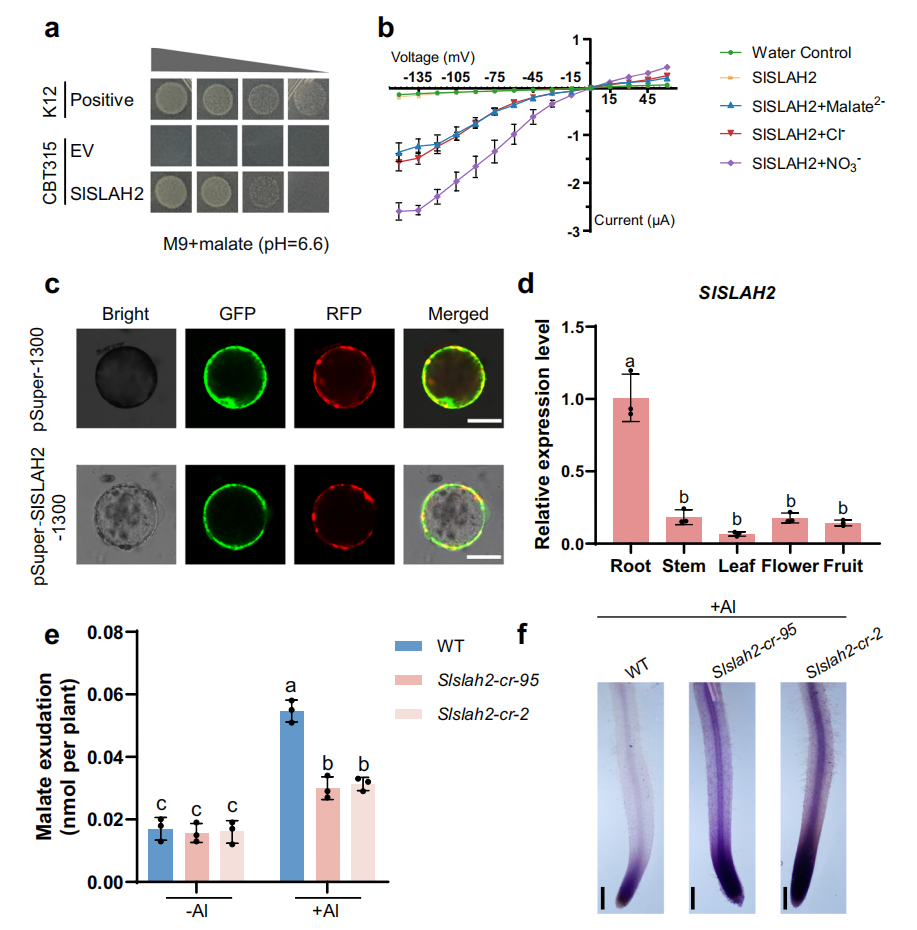 Fig. 2 | SlSLAH2 was a plasma membrane?localized malate transporter. a SlSLAH2 partly restored the growth defect of dicarboxylate?uptake?deficient E. coli mutant CBT315. The SlSLAH2?pKK223?3 vector and pKK223?3 empty vector (EV) was transferred into CBT315, respectively. WT (K12) transfected with the EV was set as positive control. The positive transformed monoclonal plaque was cultured on M9 agar medium with 10 mM malate (pH 6.6) as the sole carbon source for 3 days. b SlSLAH2 was an anion channel. Average steady?state current–voltage (I–V) curves of SlSLAH2 anion channels recorded in the indicated external solutions. The number of oocytes tested was 3 (water control and SlSLAH2) and 5 (SlSLAH2 + 50 mM Malate2? , SlSLAH2 + 50 mM Cl? , SlSLAH2 + 50 mM NO3? ). Error bars indicate means ± SE. c Subcellular location of SlSLAH2. pSuper?SlSLAH2?1300 was transiently expressed in N. benthamiana leaves. RFP was used to visualize plasma membrane, PMH (Plasma Membrane?Localized H+?ATPase) was set as plasma membrane marker. pSuper?1300 was set as a mock control. Scale bar, 50 μm. d Tissue?specific expression analysis of SlSLAH2 in tomato. SlUBI was used as reference gene. Data were presented as means ± SD (n = 3). Statistical significance was analyzed by one?way ANOVA, different lowercase letters indicated significantly different means (Tukey’s multiple comparisons test, p ≤ 0.05). e Malate exudation in roots of MicroTom WT lines and Slslah2 mutant lines. One?month?old tomato plants were treated with 0.5 mM CaCl2, 90 μM AlCl3 (pH 4.7) for 12 h. Data were presented as means ± SD (n = 3). Statistical significance was analyzed by two?way ANOVA, different lowercase letters indicated significantly different means (Tukey’s multiple comparisons test, p ≤ 0.05). f Hematoxylin staining of root Al content. Roots of 14?day?old WT and Slslah2 mutants treated with 90 μM Al3+ were stained with hematoxylin.
模块 3:上游转录因子 SlWRKY37 调控 SlSLAH2 转录表达
研究逻辑:排除经典耐铝转录因子 SlSTOP1 直接调控 SlSLAH2;启动子分析发现 W?box 元件,筛选 SlWRKY37;通过分子互作、遗传材料证明 SlWRKY37 直接激活 SlSLAH2。
核心实验:SlSLAH2 启动子元件预测;酵母单杂交 Y1H、EMSA 凝胶迁移;双荧光素酶 LUC/REN 报告;Slwrky37 突变体 RT?qPCR;Slwrky37、SlSLAH2 遗传材料根长、苹果酸外排表型与回补实验。
关键实验结果:
SlSTOP1 不直接转录激活 SlSLAH2;SlSLAH2 启动子存在 WRKY 结合 W?box 元件。
Y1H、EMSA 证明 SlWRKY37 特异性结合 W?box;双荧光素酶证实 SlWRKY37 激活 SlSLAH2 启动子活性。
Al3+诱导 SlWRKY37 表达早于 SlSLAH2;Slwrky37 突变体中 Al3+无法有效诱导 SlSLAH2 上调。
铝胁迫条件下 Slwrky37、Slslah2 突变体根伸长受严重抑制,苹果酸分泌降低;在 Slwrky37 突变体回补 SlSLAH2 可部分恢复耐铝表型,证明 SlWRKY37?SlSLAH2 处在同一遗传通路。
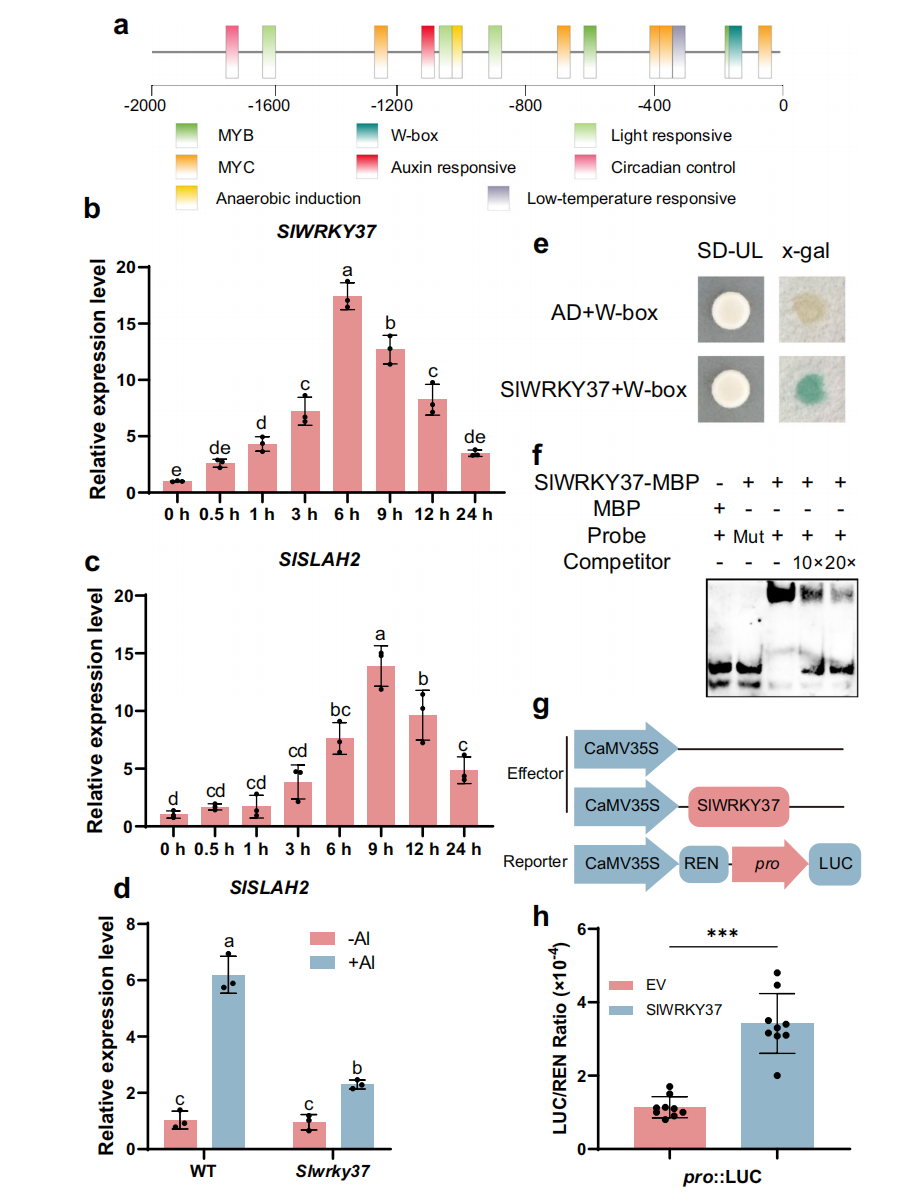 Fig. 3 | SlWRKY37 regulated SlSLAH2 expression under Al stress. a Promoter analysis of SlSLAH2. b, c The expression levels of SlWRKY37 and SlSLAH2 in 14?day?old WT treated with 60 μM AlCl3 (pH 4.7) over time were detected by RT?qPCR. SlUBI was used as reference gene. Data were presented as means ± SD (n = 3). Statistical significance was analyzed by one?way ANOVA, different lowercase letters indicated significantly different means (Tukey’s multiple comparisons test, p ≤ 0.05). d The expression level of SlSLAH2 in 14?day?old WT and Slwrky37 mutant lines treated with or without 60 μM AlCl3 (pH 4.7) for 9 h was detected by RT?qPCR. SlUBI was used as reference gene. Data were presented as means ± SD (n = 3). Statistical significance was analyzed by two?way ANOVA, different lowercase letters indicated significantly different means (Tukey’s multiple comparisons test, p ≤ 0.05). e Y1H assay. The SLAH2 promoter fragment containing W?box was cloned into pLacZi vector, SlWRKY37 was cloned into pGAD424 vector. The transformants pGAD424 and fragment were set as negative control. Transformants with paired constructs were grown on SD?UL medium and then used for binding assay in Z?buffer with X?gal. f EMSA assay. Unlabeled probe was set as competitive probe. Mut indicated mutated competitive probe. g, h LUC/REN assay. SlWRKY37 was cloned into pGreen II 62?SK. The fragment of SlSLAH2 was fused with the LUC as reporter. Empty vector (pGreen II 62?SK) co?expressing with reporter was set as the control. Data were presented as means ± SD (n = 9). Statistical significance was analyzed by paired two?tailed t test (***p ≤ 0.001).
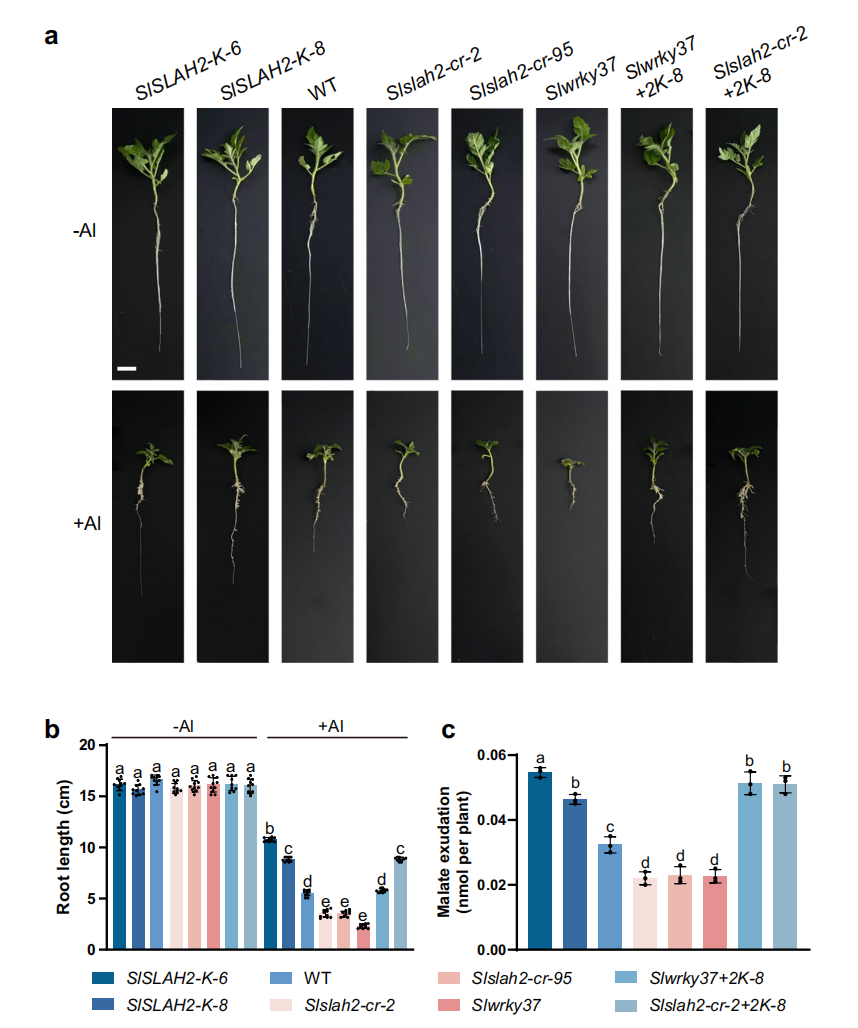 Fig. 4 | SlSLAH2 enhanced the Al tolerance by increasing the exudation of malate in tomato. a Root growth of WT, SlSLAH2 overexpression lines and knockout lines under normal condition and Al stress. 7?day?old tomato plants were grown in modified Hoagland medium supplemented with 0 or 30 μM AlCl3 (pH 4.5) for 14 d. Scale bar, 2 cm. b Root length of different lines in (a). Root length was shown without or with Al3+ treatment for 14 days. Data were presented as means ± SD (n = 10). Statistical significance was analyzed by one?way ANOVA, different lowercase letters indicated significantly different means (Tukey’s multiple comparisons test, p ≤ 0.05). c Malate exudation of different lines. One?month?old tomato plants treated for 12 hours with 0.5 mM CaCl2, 90 μM AlCl3 (pH 4.7) was used for malate exudation. Data were presented as means ± SD (n = 3). Statistical significance was analyzed by one?way ANOVA, different lowercase letters indicated significantly different means (Tukey’s multiple comparisons test, p ≤ 0.05).
模块 4:激酶 SlCDPK21 介导 SlSLAH2 蛋白 Thr167 位点磷酸化激活
研究逻辑:铝胁迫诱发胞质 Ca2+升高,验证 SlSLAH2 发生 Al3+?依赖磷酸化;筛选 SlCDPK21,验证蛋白互作、体外激酶、磷酸化位点;Slcdpk21 敲除 / 过表达材料解析生理功能。
核心实验:蛋白磷酸化免疫印迹;Co?IP、LCI、BiFC 蛋白互作;体外激酶实验;质谱鉴定磷酸化位点 Thr167;Slcdpk21 CRISPR 敲除与过表达株系根长、苹果酸外排、蛋白磷酸化检测。
关键实验结果:
Al3+处理显著提升 SlSLAH2 蛋白磷酸化水平。
Co?IP、LCI、BiFC 证实 SlCDPK21 与 SlSLAH2 在质膜发生蛋白相互作用。
体外激酶实验证明 SlCDPK21 以 Ca2+?依赖方式磷酸化 SlSLAH2,质谱鉴定 Thr167 为关键磷酸化位点;将 T167 突变为 A 后磷酸化信号显著下降。
Slcdpk21 敲除株铝胁迫根生长受抑,苹果酸外排降低;过表达株耐铝性提升;突变体背景 SlSLAH2 蛋白磷酸化水平显著下降,证实 SlCDPK21 是铝胁迫下 SlSLAH2 体内关键激酶。
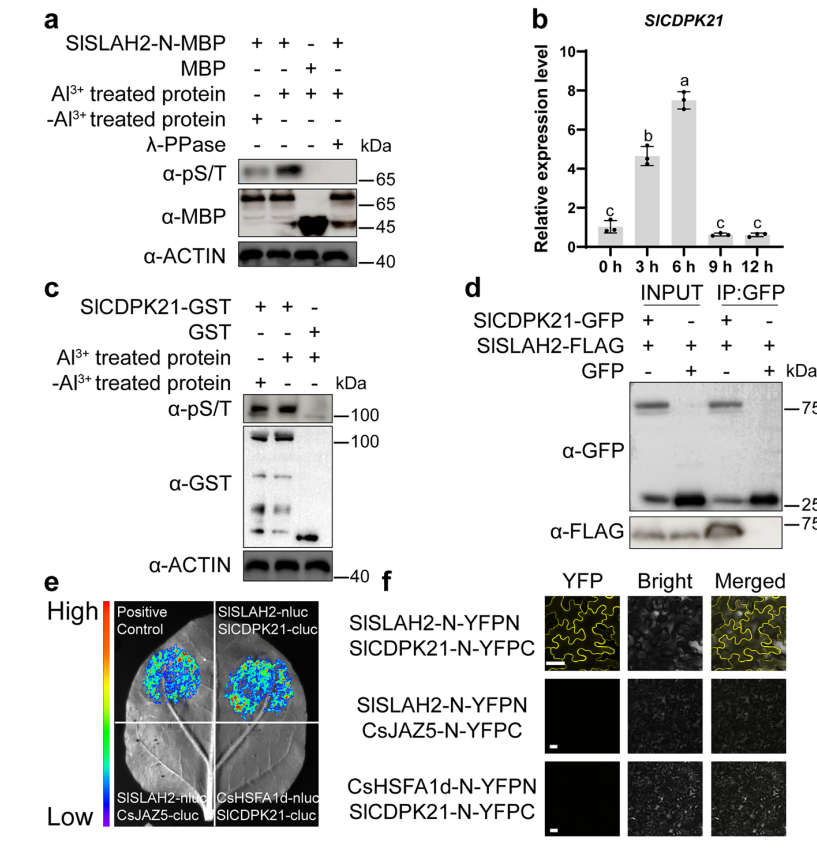 Fig. 5 | SlCDPK21 directly interacted with SlSLAH2. a Phosphorylation of the N terminus of SlSLAH2 induced by 0 or 90 μM AlCl3. Total proteins were extracted from 0 or 90 μM AlCl3 treated tomato roots of WT. The samples derived from the same experiment and that blots were processed in parallel. b The expression level of SlCDPK21 in WT treated with 60 μM AlCl3 (pH 4.7) in different time points were detected by RT?qPCR. SlUBI was used as reference gene. Data were presented as means ± SD (n = 3). Statistical significance was analyzed by one?way ANOVA, different lowercase letters indicate significantly different means (Tukey’s multiple comparisons test, p ≤ 0.05). c Phosphorylation of SlCDPK21 induced by 0 or 90 μM AlCl3. Total proteins were extracted from 0 or 90 μM AlCl3 treated tomato roots of WT. The samples derived from the same experiment and that blots were processed in parallel. d Co?IP assay showed SlCDPK21 interacted with SlSLAH2. SlSLAH2?FLAG and SlCDPK21?GFP were transiently co?transfected into N. benthamiana leaves. e LCI assay showed the interaction between SlCDPK21 and SlSLAH2. Constructs carrying SlCDPK21?cluc and SlSLAH2?nluc were co?expressed in N. benthamiana leaves for 3 d. CsHSFA1d?nluc and CsJAZ5?cluc were used as positive control. f BiFC assay showed that the interaction between SlCDPK21 and SlSLAH2 occurred at the plasma membrane. SlCDPK21?N?YFPC and SlSLAH2?N?YFPN proteins were transiently co?expressed in N. benthamiana. Scale bar, 50 μm. Experiments in (a, c–f) were independently repeated three times with similar results.
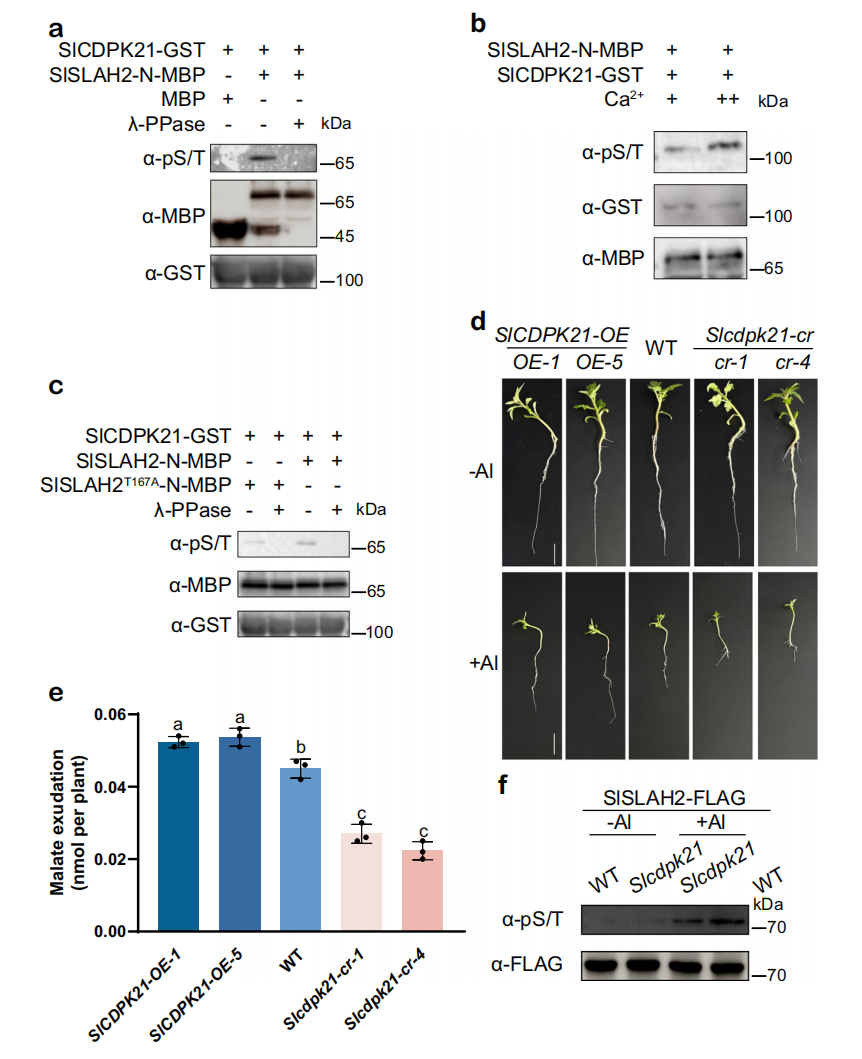 Fig. 6 | SlCDPK21 enhanced Al tolerance in tomato by increasing phosphorylation of SlSLAH2. a In vitro kinase assay showed SlCDPK21 phosphorylated SlSLAH2. Recombinant SlSLAH2 and SlCDPK21 proteins were incubated in protein kinase buffer supplemented with ATP. b In vitro kinase assay showed the phosphorylation of SlSLAH2 by SlCDPK21 was calcium?dependent. Recombinant SlSLAH2 and SlCDPK21 proteins were incubated in protein kinase buffer supplemented with ATP and either 1 mM or 5 mM CaCl2. c In vitro kinase assay showed T167 of SlSLAH2 was a target of SlCDPK21. Recombinant SlSLAH2, SlSLAH2T167A (mutant form with the T167 replaced with A167) and SlCDPK21 proteins were incubated in protein kinase buffer supplemented with ATP. d Root growth of WT, SlCDPK21 overexpression lines and knockout lines under normal condition and aluminum stress. 7?day?old tomato plants were grown in modified Hoagland medium supplemented with 0 or 30 μM AlCl3 (pH 4.5) for 14 days. Scale bar, 2 cm. e Malate exudation of different lines. One?month?old tomato plants were treated with 0.5 mM CaCl2, 90 μM AlCl3 (pH 4.7) for 12 h. Data were presented as means ± SD (n = 3). Statistical significance was analyzed by one?way ANOVA, different lowercase letters indicated significantly different means (Tukey’s multiple comparisons test, p ≤ 0.05). f Phosphorylation levels of SlSLAH2 in WT and Slcdpk21. SlSLAH2 protein was co?incubated with WT or Slcdpk21 protein treated with 0 or 90 μM AlCl3 for 3 h. Experiments in (a–f) were independently repeated three times with similar results.
模块 5:磷酸酶 SlPP2C72 负调控 SlSLAH2,SlCDPK21 双重抑制 SlPP2C72,建立双重校验机制
研究逻辑:筛选负调控去磷酸化磷酸酶 SlPP2C72;体外去磷酸化、遗传材料证明 SlPP2C72 抑制 SlSLAH2 活性;进一步研究 SlCDPK21 同时磷酸化抑制 SlPP2C72 活性,结合 Al3+转录抑制 SlPP2C72,构建双重校验维持 SlSLAH2 高磷酸化状态。
核心实验:RT?qPCR 检测 SlPP2C72 表达;体外去磷酸化实验;Co?IP;Slpp2c72 敲除、过表达株系生理表型;磷酸酶活性测定;SlCDPK21 对 SlPP2C72 的体外激酶实验。
关键实验结果:
Al3+处理转录水平下调 SlPP2C72 表达;体外生化证明 SlPP2C72 可以对 SlSLAH2 进行去磷酸化(二者无直接物理互作,间接调控)。
Slpp2c72 敲除株铝胁迫苹果酸外排升高、耐铝增强;过表达株苹果酸分泌下降、铝敏感;突变体中 SlSLAH2 磷酸化水平升高。
Al3+抑制 SlPP2C72 磷酸酶活性;SlCDPK21 与 SlPP2C72 互作,Ca2+?依赖磷酸化 SlPP2C72,抑制其磷酸酶活性。
完整双重校验:Al3+→SlWRKY37 促进 SlSLAH2 转录;Ca2+激活 SlCDPK21,一方面直接磷酸化激活 SlSLAH2,另一方面磷酸化抑制 SlPP2C72 活性;同时 Al3+下调 SlPP2C72 转录,双重阻止 SlSLAH2 被去磷酸化,维持通道持续激活;铝胁迫解除后 SlPP2C72 恢复表达与活性,关闭 SlSLAH2,避免苹果酸过度流失。
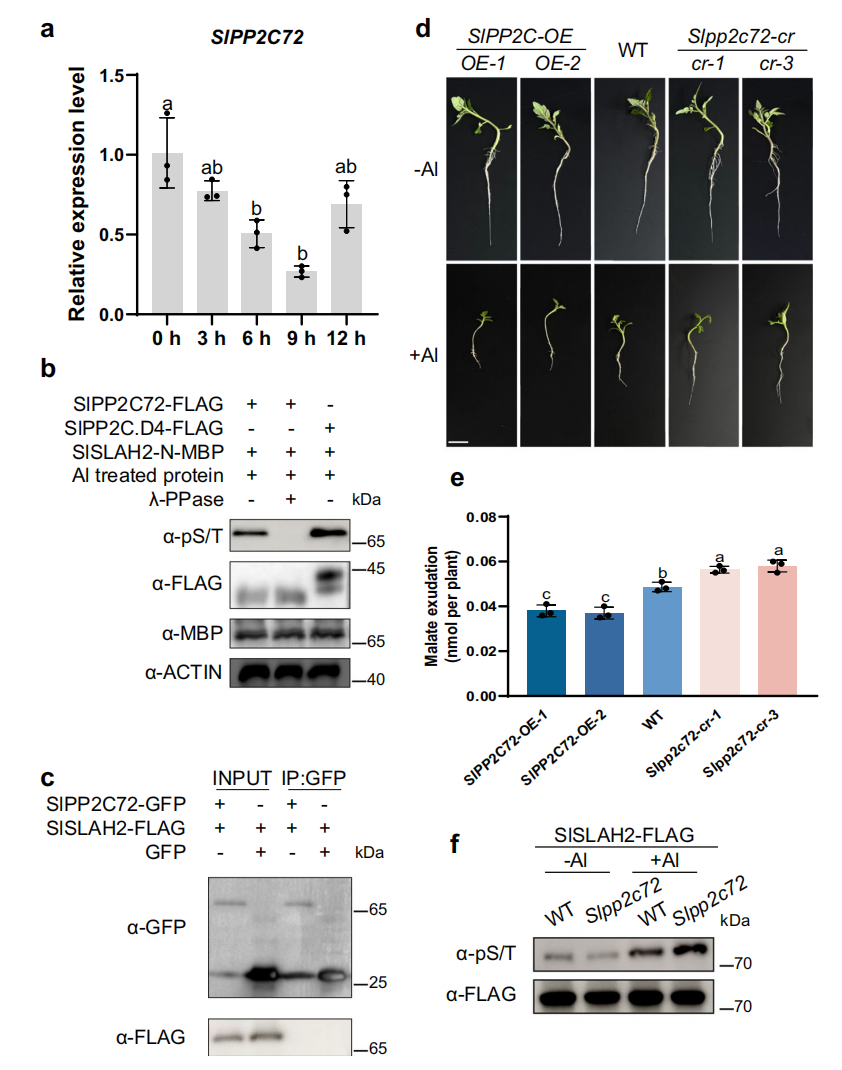 Fig. 7 | SlSLAH2 was indirectly dephosphorylated by SlPP2C72. a The expression level of SlPP2C72 in WT treated with 60 μM AlCl3 (pH 4.7) over time was detected by RT?qPCR. SlUBI was used as reference gene. Data were presented as means ± SD (n = 3). Statistical significance was analyzed by one?way ANOVA, different lowercase letters indicated significantly different means (Tukey’s multiple comparisons test, p ≤ 0.05). b SlPP2C72 dephosphorylated SlSLAH2 in vitro. Recombinant SlSLAH2 was co?incubated with 90 μM AlCl3 treated tomato root extracted proteins. Then SlPP2C72 or SlPP2C.D4 proteins were added to this system. The samples derive from the same experiment and that blots were processed in parallel. c Co?IP assay showed SlSLAH2 did not interact with SlPP2C72. SlSLAH2?FLAG and SlPP2C72?GFP were transiently co?transfected into N. benthamiana leaves, and α?GFP affinity magnetic beads were used for immunoprecipitation. d Root growth of WT, SlPP2C72 overexpression lines and knockout lines under normal condition and aluminum stress. 7?day?old tomato plants were grown in modified Hoagland medium supplemented with 0 or 30 μM AlCl3 (pH 4.5) for 14 d. Scale bar, 2 cm. e Malate exudation of different lines. One?month?old tomato plants treated with 0.5 mM CaCl2, 90 μM AlCl3 (pH 4.7) for 12 h. Data were presented as means ± SD (n = 3). Statistical significance was analyzed by one?way ANOVA, different lowercase letters indicated significantly different means (Tukey’s multiple comparisons test, p ≤ 0.05). f Phosphorylation levels of SlSLAH2 in WT and Slpp2c72. SlSLAH2 protein was co?incubated with WT or Slpp2c72 treated with 0 or 90 μM AlCl3. Experiments in (b–f) were independently repeated three times with similar results.
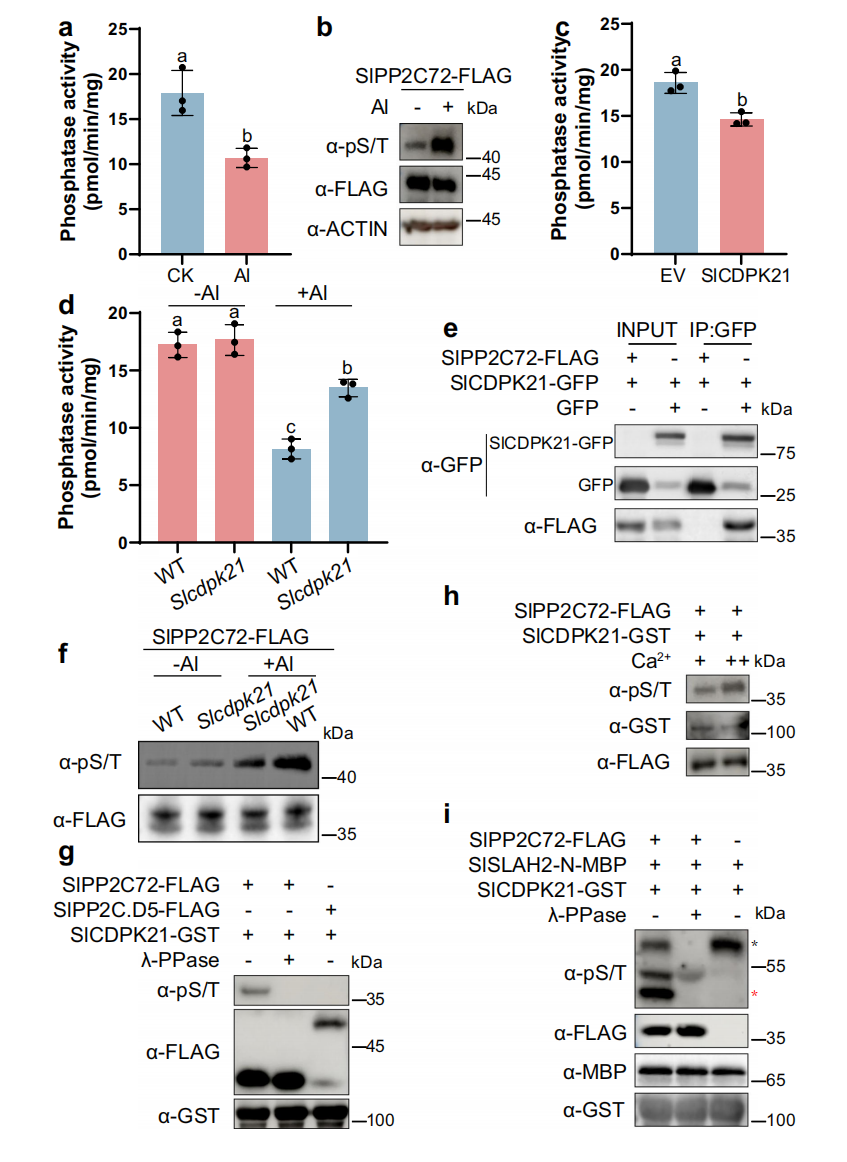 Fig. 8 | SlCDPK21 phosphorylated SlPP2C72 to ensure SlSLAH2 high phosphorylation state. a Effect of Al3+ on phosphatase activity of SlPP2C72. Total protein extracts from WT tomato plants treated with 0 or 90 μM AlCl3 were incubated with SlPP2C72. Data were presented as means ± SD (n = 3). Statistical significance was analyzed by unpaired two?tailed t test, different lowercase letters indicated significantly different means (p ≤ 0.05). b Phosphorylation of SlPP2C72 induced by 0 or 90 μM AlCl3. (samples derived from the same experiment, with blots processed in parallel). c Effect of SlCDPK21 on phosphatase activity of SlPP2C72. Data were presented as means ± SD (n = 3). Statistical significance was analyzed by unpaired two?tailed t test, different lowercase letters indicated significantly different means (p ≤ 0.05). d Effect of SlCDPK21 on phosphatase activity of SlPP2C72. SlPP2C72 was co?incubated with WT or Slcdpk21 protein treated with 0 or 90 μM AlCl3. Data were presented as means ± SD (n = 3). Statistical significance was analyzed by one?way ANOVA, different lowercase letters indicated significantly different means (Tukey’s multiple comparisons test, p ≤ 0.05). e Co?IP assay showed SlCDPK21 interacted with SlPP2C72. The α?GFP affinity magnetic beads were used for immunoprecipitation. f Phosphorylation levels of SlPP2C72 in WT and Slcdpk21. SlPP2C72 was co?incubated with 0 or 90 μM AlCl3 treated proteins from WT or Slcdpk21. g In vitro kinase assay showed SlCDPK21 phosphorylated SlPP2C72. SlPP2C72 and SlCDPK21 proteins were incubated in protein kinase buffer supplemented with ATP. h In vitro kinase assay showed the phosphorylation of SlPP2C72 by SlCDPK21 was calcium?dependent. SlPP2C72 and SlCDPK21 proteins were incubated in protein kinase buffer supplementing ATP with 1 mM or 5 mM CaCl2. i In vitro kinase assay showed SlCDPK21 simultaneously phosphorylated SlPP2C72 and SlSLAH2. SlPP2C72, SlSLAH2, and SlCDPK21 proteins were incubated in Al3+ treated proteins. Red and black stars separately indicated the phosphorylated SlPP2C72 and SlSLAH2. Experiments in (a–i) were independently repeated three times with similar results.
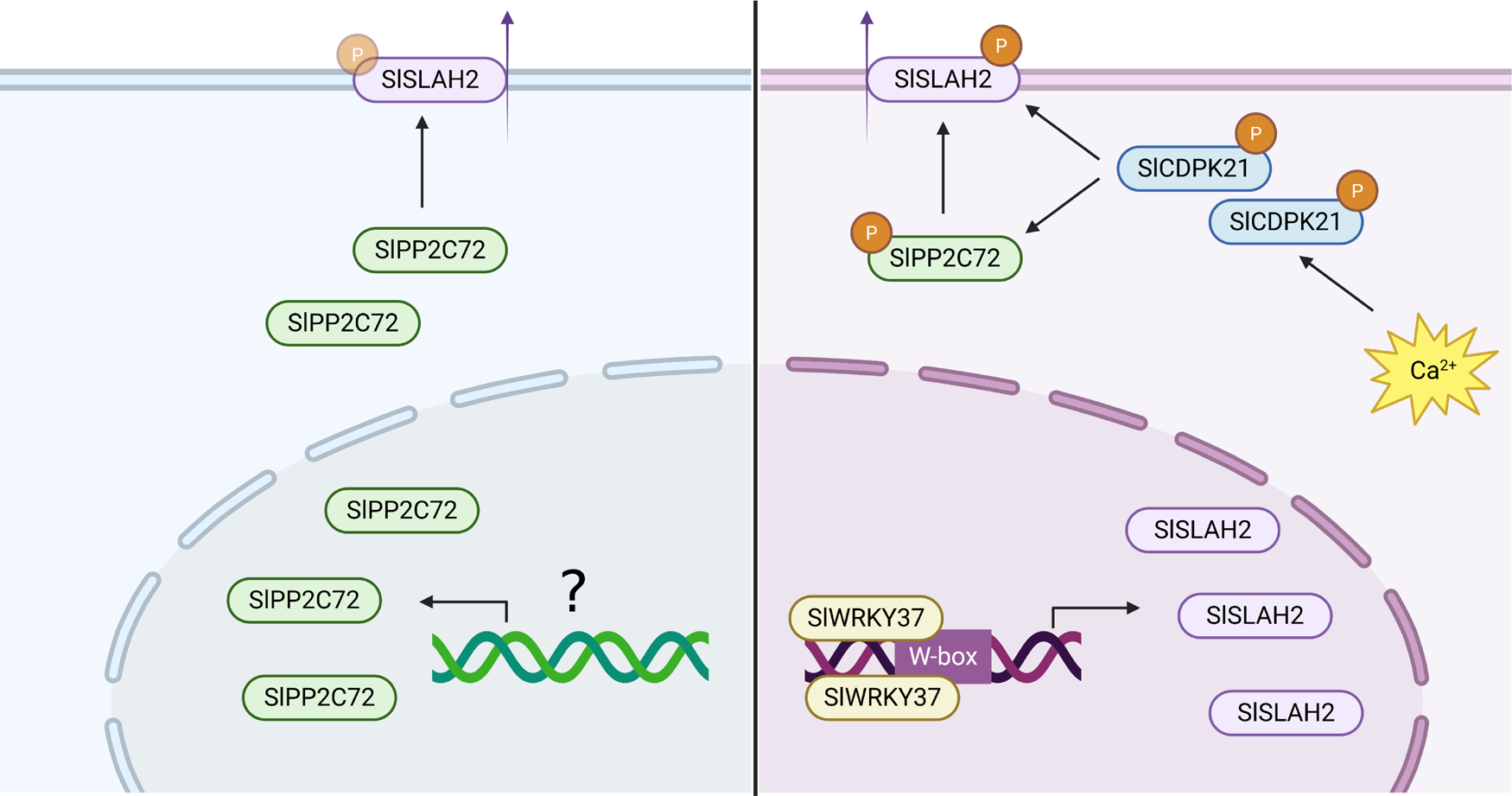 Fig. 9 | Working model of SlSLAH2?mediated malate exudation under aluminum stress in tomato. Al3+ triggered the SlWRKY37 to activate the expression of SlSLAH2, and Al3+ also activated SlCDPK21 to cause the phosphorylation of SlSLAH2 to promote malate exudation to increase tomato aluminum tolerance; Meanwhile, SlPP2C72 was suppressed by aluminum stress at the transcription level and the phosphorylation by SlCDPK21 reduced its phosphatase activity to disrupt the dephosphorylation of SlSLAH2, therefore, forming a double?check to sustain SlSLAH2 phosphorylation. Created in BioRender. (2026) https://BioRender.com/ds8k1s3.
五、爱必信(Absin)产品整体作用总结
本研究使用abs60154 Trizol 试剂完成番茄不同铝处理梯度根系样品总 RNA 提取。高质量总 RNA 是 RT?qPCR 基因表达检测、转录组测序的前置基础;该试剂稳定提取逆境植物根尖 RNA,保障 SlALMT、SlSLAH 家族、SlWRKY37、SlCDPK21、SlPP2C72 等全套基因转录水平数据可靠输出,支撑从候选基因筛选到转录调控模块整套实验,为本篇解析番茄新型耐铝通路的高分 Nature Communications 研究提供关键核酸样本制备工具。
相关产品
| 货号 | 品名 | 链接 |
| abs60154 | Trizol Reagent(总RNA提取试剂) | https://www.absin.cn/ |

- 手机:13761418683